


Before confirming Polish citizenship by descent, you need to prove that you have Polish ancestors. Discover the criteria and how to quickly check if you qualify.
Confirming Polish citizenship by descent is an opportunity for individuals with Polish ancestry to confirm citizenship and enjoy the privileges of being an EU citizen.
Many people from countries such as the USA, Canada, the UK, Australia, and New Zealand, who have Polish ancestors, realize they are entitled to Polish citizenship and decide to take advantage of it.
If you have a parent, grandparent, or great-grandparent born in Poland, there’s a good chance you inherited Polish citizenship from them, which means a Polish passport and EU citizenship.
This means that if you prove your ancestors’ Polish citizenship, you are entitled to Polish citizenship from birth.
In this article, I will discuss the criteria you need to meet to successfully confirm your Polish citizenship based on your Polish roots and how to do it quickly.
Key Takeaways
- What is the process for confirming for Polish citizenship by descent?
- What criteria must be met?
- How quickly can you check if you qualify?
- How can we help you?
Citizenship Law in Poland
Let’s start with the fact that citizenship law in Poland differs from the law in countries like the USA or Canada.
Polish law is based on the principle of “jus sanguinis“ (Latin for “right of blood”), which states:
Right of blood
“Citizenship is acquired by being born to parents, at least one of whom is a citizen of that country, regardless of the place of birth.”
This means that you can inherit Polish citizenship from your ancestors, and having just one Polish ancestor in your family is enough.
In the USA and Canada, in contrast to Polish law, the principle of “jus soli” (Latin for “right of the soil”) applies, which means citizenship is acquired by being born on the territory of that country.
Therefore, any child born in the USA or Canada automatically becomes a citizen of that country, regardless of their parents’ citizenship.
I often explain this difference to our clients from the USA and Canada, adding that after passing the free eligibility test, they have Polish citizenship from birth. Now, they need to officially confirm it and then obtain a Polish passport.
In summary, Polish law allows for the retention of Polish citizenship across generations, even if the family emigrates and children are born outside of Poland. Poland allows dual citizenship, meaning individuals do not need to renounce their existing citizenship when acquiring Polish citizenship. However, Polish citizens must use Polish documents when dealing with Polish authorities.
For more detailed information, read our article on Polish citizenship law.
Check if you qualify for polish citizenship by descent

Polish citizenship requirements: by descent vs other routes
Obtaining Polish citizenship is a broad concept that covers several legal routes, each with different eligibility criteria and requirements. Polish citizenship by descent is one specific route, with requirements focused on proving citizenship through your Polish ancestry rather than meeting the criteria for other routes to Polish citizenship.
| Route | Who is eligible? | Main requirements or basis | Official resources |
| Confirmation of Polish citizenship by descent | People with Polish ancestors who may have inherited Polish citizenship | Evidence of an ancestor’s Polish citizenship, family relationships, and the applicable citizenship laws. (More about requirements related to Polish citizenship by descent are below). | Confirmation of Polish citizenship by descent, |
| Recognition as a Polish citizen | Foreign nationals who meet statutory eligibility conditions | Qualifying legal residence in Poland (at least 2 years) and other applicable requirements, which may include stable income, housing, and proof of Polish-language proficiency. | Application for the recognition as a Polish citizen |
| Granting Polish citizenship by the President of Poland | Foreign nationals who are applying for Polish citizenship | An application to the President of Poland through a Polish consular post of your territorial jurisdiction. The president decides whether to grant citizenship. | Granting Polish citizenship |
| Restoration of Polish citizenship | Former Polish citizen who lost Polish citizenship | Proof of previous Polish citizenship and satisfaction of the statutory conditions for restoration. | Restoring Polish citizenship |
What are the Polish citizenship by descent requirements?
The main Polish citizenship by descent requirements relate to proving your Polish ancestors, including establishing your ancestors’ Polish citizenship, and showing that citizenship was passed down through your family line.
Meeting these criteria is essential for a successful application. Individuals with Polish origin can leverage their heritage for possible citizenship benefits.
Below is a list of criteria considered during qualification:
| You must have at least a Polish ancestor who held Polish citizenship | At least one person in your direct family line – such as parent, grandparent, or great-grandparent – must have held Polish citizenship. However, being born in Poland or even having Polish nationality, or ancestry alone is not sufficient. You must establish that your ancestor legally held Polish citizenship. |
| Polish citizenship must have been passed down through every generation | You must demonstrate an unbroken legal chain of citizenship from your Polish ancestor to yourself. For example, if your great-grandmother was Polish citizen, you must establish that citizenship was passed down to your grandparent, then to your parent, and ultimately to you under the laws at each stage. You need to know Polish citizenship law differs in years 1920-1951, 1951-1962, 1962-2012. |
| Your ancestor must not have lost Polish citizenship before passing it down | When you think about a Polish citizenship by descent requirements, this one is crucial. The question is did your ancestor lose Polish citizenship before the next generation was born. Depending on the historical period, acquiring foreign citizenship, serving in a foreign military (ie. during World War II), or holding public office abroad may affect holding Polish citizenship. However, the applicable rules and exceptions changed over time, so each case requires an individual legal assessment. |
| Relevant historical Polish citizenship laws must be considered | As you know, Polish citizenship legislations have changed over the years. The citizenship act of 1920, followed by the laws of 1951 and 1962, and the most current from 2009 (but entered into force in 2012) – they are introducing different rules governing the obtaining and loss or obtaining of citizenship. |
| You must provide a reliable documents establishing your family line and your ancestors’ citizenship | You need documents that establish both your relationship to your Polish ancestor and ancestor’s Polish citizenship. These may include birth and marriage certificates, Polish passports, identity documents, military records, population registers, or other archival records. If some of them are missing , alternative historical records may help to establish relevant facts. During the whole process a genealogical researcher or a Polish citizenship by descent law firm may be able to assist locating with locating and obtaining the necessary records. |
Why is the Year 1920 Important?
You must remember that Poland, with its rich and tumultuous history, did not exist as a sovereign state for a long period (over 120 years) before 1920, being divided among three occupying powers (Russian, Prussian, and Austro-Hungarian empire).
Only after World War I, in 1918, did Poland regain independence, and in 1920, the citizenship laws of the newly re-established state were formally established. Individuals with ancestors from former Polish territories can also be eligible for Polish citizenship.
Did you know?
Our experts have a 98% success rate in positive decisions on Polish citizenship by descent, especially when the client’s ancestors left Poland after 1920.
So ideally, the ancestor should have lived in Poland before 1920. Otherwise, the case can become quite complicated, and the chances of success may be uncertain. Read more if your ancestors left Poland before 1920.
In other hand, if your ancestors left Poland after 1920, your chances of confirming Polish citizenship are very high.
How to Quickly Check if You Qualify?
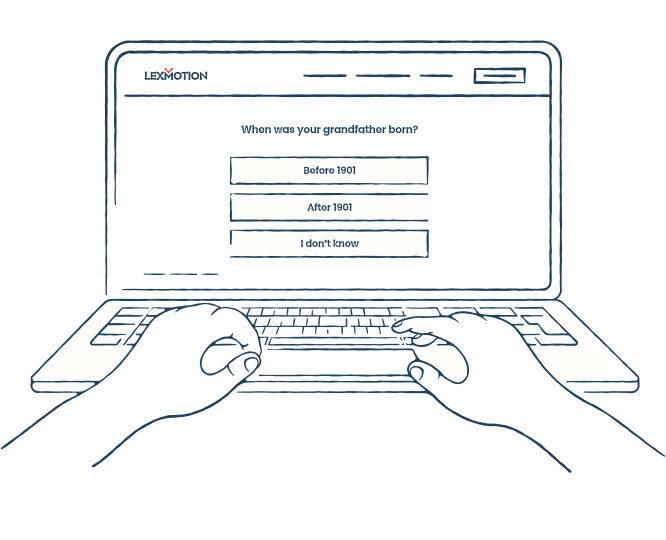
The simplest ways to quickly check if you qualify for Polish citizenship by descent is by taking our free 5-min test.
Our test was created based on many years of working with thousands of clients worldwide. It considers important legal issues, historical elements, and citizenship regulations, allowing for a quick and simplified assessment of whether you meet the required criteria.
Check if you qualify for polish citizenship by descent
Summary
Remember, to confirm Polish citizenship by descent, you must confirm your Polish roots.
To qualify, you need at least one ancestor who was a Polish citizen and did not lose that citizenship. Ancestors must come from a direct line, such as parents, grandparents, or great-grandparents.
It is also important that the ancestors lived in Poland after 1920 and had the appropriate documentation to prove their citizenship. Additionally, holding a permanent residence permit for a certain duration can also qualify individuals for Polish citizenship.
You can start the qualification process by taking our free qualification quiz.
If your test is positively evaluated, we can help you through the entire process of confirming Polish citizenship by descent.
The Process of Confirming for Polish Citizenship by Descent
When someone wants to confirm Polish citizenship based on descent, they need to meet specific requirements to have their citizenship recognized. There are several ways to obtain Polish citizenship, but the confirmation process by descent is the most popular among our clients.
In practice, this means that before confirming Polish citizenship by descent, you should ensure that you meet the eligibility criteria.
The entire process of confirming for Polish citizenship can be described in three stages:
- Eligibility Assessment
The eligibility qualification stage involves a preliminary check to see if a person meets the basic criteria for confirming Polish citizenship by descent.
This stage includes analyzing whether the applicant has ancestors who were Polish citizens and did not lose this citizenship.
Did you know?
To confirm Polish citizenship by descent, you only need to confirm one ancestor.
Find more detailed information about the criteria below.
- Document Search
Confirming Polish citizenship involves gathering and submitting the appropriate documents that confirm Polish descent.
You must provide birth certificates, marriage certificates, Polish passports, identity cards, and other documents of your ancestors.
Additionally, you need to translate the documents into Polish and submit the application for citizenship recognition to the relevant authorities.
- Official Confirmation
In this stage, Polish authorities review the submitted documents and decide on confirming citizenship.
This is a crucial moment as it formally confirms the applicant’s citizenship status. Children of recognized Polish citizens are automatically granted Polish citizenship, and individuals over the age of 16 must meet specific requirements.
By choosing to work with Lexmotion experts, remember that the entire process can be completed remotely, without needing to visit Poland or speak Polish.
For more detailed information, read our article on the process of applying for Polish citizenship by descent.
Frequently Asked Questions
Is it true that knowledge of the Polish language is not required to confirm Polish citizenship by descent?
You do not need to know Polish to confirm Polish citizenship by descent. If you meet all the eligibility criteria, Polish citizenship is yours by birth – no language test is required to confirm citizenship.
Can I confirm Polish citizenship by descent?
If you have Polish ancestry, it is possible. Once you complete our free quiz, our team of experts will assess whether you qualify. It is one of the quickest ways to get an answer to the questions “Am I eligible for Polish citizenship?” or “Do I qualify for Polish citizenship by descent?” often asked by those with Polish ancestors.
Is it true that having an old Polish passport of my grandmother or great-grandmother improves my chances of success?
The law on Polish citizenship was more patriarchal in certain periods. After completing our free eligibility test for Polish citizenship by descent, we will consider the relevant regulations in force at the time and assess your situation. We will help you understand how to confirm Polish citizenship and the steps to take.
What documents are needed to confirm Polish citizenship by descent?
These include your ancestor’s military records, documents, and service numbers; census records where your ancestor was registered; a Polish passport; the ancestor’s birth certificate; a Polish ID card; and Polish population records. In many cases, one of these documents is sufficient.
You must also provide documents proving your descent, such as your own and your parents’ birth certificates.
What is the process to acquire Polish citizenship?
To acquire Polish citizenship, individuals must navigate the legal framework outlined in the Polish Citizenship Act. This includes processes such as citizenship by descent, where parentage plays a crucial role, and naturalization. The Act details the rights and obligations of Polish citizens, including the right to a passport and regulations surrounding dual citizenship.
How does the President of Poland handle granting Polish citizenship?
The President of Poland has the authority to grant Polish citizenship through a naturalization process. This procedure can be lengthy and requires applicants to provide substantial justification for their applications. The President’s decision is based on the merits of each case and the applicant’s ability to meet the necessary criteria.
What role does the Polish consulate play in the citizenship process?
The Polish consulate is pivotal in the citizenship process. Applicants must submit their documentation and applications at their local Polish consulate. The consulate facilitates the processing of citizenship claims and the issuance of passports, making it an essential part of the administrative tasks involved in confirming Polish citizenship.
How does the Polish government manage citizenship laws?
The Polish consulate is pivotal in the citizenship process. Applicants must submit their documentation and applications at their local Polish consulate. The consulate facilitates the processing of citizenship claims and the issuance of passports, making it an essential part of the administrative tasks involved in confirming Polish citizenship.
Are there any rules regarding Polish citizenship that I should know about?
Our guide to Polish citizenship law contains all the essential information. The Polish government processes applications for citizenship confirmation and outlines the administrative procedures. It will provide you with everything you need to know about the Polish Citizenship Act and the legal procedures you must follow when confirming citizenship by descent.
My ancestors were Polish, but they lived in former Polish territories like Ukraine/Lithuania. Can you help me?
Our team of experts has years of experience dealing with complex cases like these and may be able to help you confirm citizenship by descent. If you have Polish relatives who lived in Ukraine or Lithuania, complete our free eligibility test, and we will assess your situation. Eligibility can also extend to ancestors from former Polish territories.